
 85243 85243 |
 35212 35212 |
|
|
||
|
|
|||||||
| Welcome to the Exploding Garrmondo Weiner Interactive Swiss Army Penis. |
|
GFF is a community of gaming and music enthusiasts. We have a team of dedicated moderators, constant member-organized activities, and plenty of custom features, including our unique journal system. If this is your first visit, be sure to check out the FAQ or our GFWiki. You will have to register before you can post. Membership is completely free (and gets rid of the pesky advertisement unit underneath this message).
|
 |
|
|
Thread Tools |
 Member 617 Level 43.41 Mar 2006 
|
I'm currently using the GENKI series of textbooks as you can see:
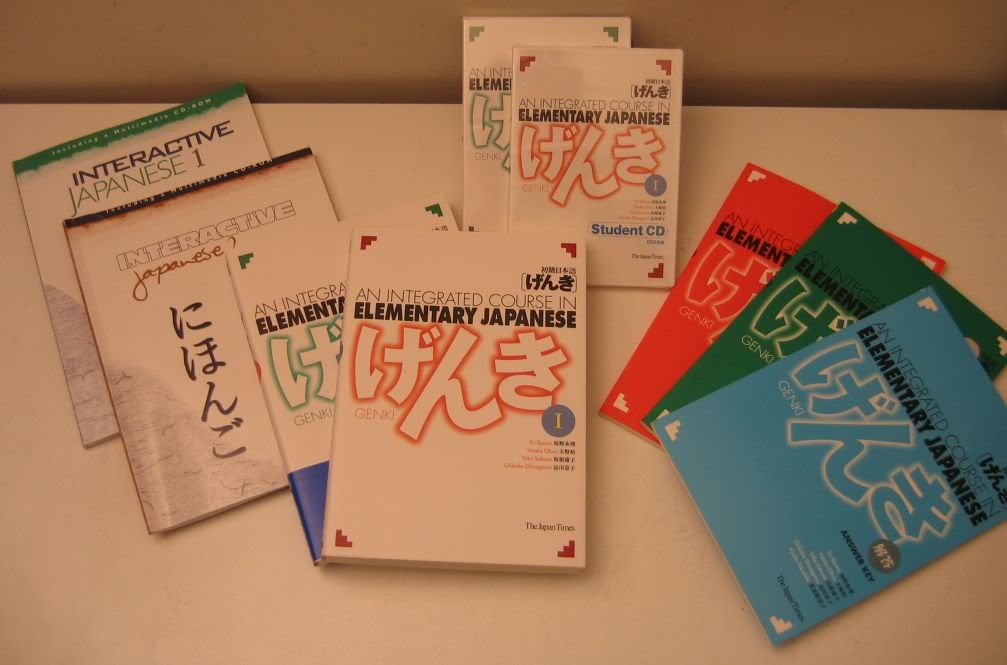 I find the approach they use isn't quite as direct as the Interactive Japanese, published at my local university but it's quite informative and gives you more background into how and why a particular grammatical structure is used. It's aimed at somewhat higher level of English readers though, surprisingly. One note I have is I find that they introduce kanji a bit too quickly, but most of the kanji is accompanied by furigana. If you keep at it everyday and do the exercises concluding each chapter, then I think some decent progress can be made if you do self studying. BTW, would anyone know what the approximate JLPT Kyuu level the first and second textbooks are aimed at? EDIT: Sorry for stretching the tables as I'm using a work computer and it doesn't have an image resizing program. Gomen nee. ;_; Jam it back in, in the dark.  - What we all do best - |
Member 617 Level 43.41 Mar 2006
|
 Yes, regarding the kana - the two alphabets - hiragana and kata, I'd advise you to follow this method to learn it ASAP. Don't spend two months like how I did just to rewrite the stupid A I U E O table 500 times. Here's how you do it (or I did it, and got it down pact within 3-4 days instead of taking forever): For Hiragana 1) Right down the "A" hiragana 10 times in a row, and get a good book or online that shows you the proper stroke order. VERY IMPORTANT! Also make sure you pronounce these correctly. This should be pronounced as "AHHH" like when you go to the doctor. 2) Move on to "E" kana and do the same. Sorry as I'm using my work computer and cannot use Japanese font. 3) Continue this until you get to the "O". Now close the books and test yourself. Testing yourself is the best way to memorize, as while it took me about 3-4 days with hiragana, kata was picked up much faster - within a day, since many of them do look similar to hiragana. 4) Once you've got yourself from a i u e o to ka ki ku ke ko and all the way down, start writing it in tables and if you can do that, then that's great. 5) Use flash cards. You can make this yourself with cutting up paper. Write the kana on one side and the romaji (English expression) on the other. Put them in a hat and draw them up and recite what you have. If you picked up a "U", then write the kana for it. 6) That's pretty much the basics. But to get the alphabet down as well, start writing simple words, like konnichiwa etc. You should already by now note how to use Ko - n- ni - chi - wa, those 5 kana's to come up with the word. Most amazing jew boots - What we all do best - |
Member 617 Level 43.41 Mar 2006
|
How ya doing, buddy? - What we all do best - |
Member 617 Level 43.41 Mar 2006
|
All in all, I think Genki is a good series, but now on reflection it's not very newb friendly, especially the explanation of the verb system and changing from masu to u and ru form (Genki does this backwards starting with the u/ru form going to masu). This series should perhaps be picked up at a later time, perhaps 6 months after you've got a more elementary textbook as suggested above.
I am a dolphin, do you want me on your body? - What we all do best - |
Member 617 Level 43.41 Mar 2006
|
I was speaking idiomatically. - What we all do best - |
Member 617 Level 43.41 Mar 2006
|
Speaking of all this, I just got my pratice copy of the Kyuu 3/4 JLPT test today in the mail. I'll be putting that aside until a few months when I'm ready to test myself out.
How ya doing, buddy? - What we all do best - |


 .
.