
 85243 85243 |
 35212 35212 |
|
|
||
|
|
|||||||
| Welcome to the Exploding Garrmondo Weiner Interactive Swiss Army Penis. |
|
GFF is a community of gaming and music enthusiasts. We have a team of dedicated moderators, constant member-organized activities, and plenty of custom features, including our unique journal system. If this is your first visit, be sure to check out the FAQ or our GFWiki. You will have to register before you can post. Membership is completely free (and gets rid of the pesky advertisement unit underneath this message).
|
| View Poll Results: Math-Invention or Discovery | |||
| Invention |
  
|
23 | 41.07% |
| Discovery |
  
|
20 | 35.71% |
| ???? |
  
|
9 | 16.07% |
| Delicious cake |
  
|
4 | 7.14% |
| Voters: 56. You may not vote on this poll | |||
 |
|
|
Thread Tools |
 Member 5982 Level 14.90 Apr 2006 
|
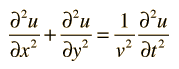 . In the case where there is dampening on that wave the energy lost is determined by complex numbers. Hell any level of physics 300+ has you using complex numbers ALL the time. . In the case where there is dampening on that wave the energy lost is determined by complex numbers. Hell any level of physics 300+ has you using complex numbers ALL the time.As for non Euclidian geometry off the top of my head I'd say you can use that for orbits, specifically those of comets which either follow elleptical or parabolic orbits. I'm sure some current mathematics don't have a physical meaning yet, but this is has always been the case. Number Theory was invented in the mid 1500s in Europe and can be traced back even further than that through the Greeks and other civilizations. Now? It's the basis for cryptology and computer encryption. The question at hand is a very good one. On one hand you can say that Calculus was invented as the result of algebraic derivations, but on the other because it describes the behavior of practically any physical system humans only discovered the way in which the universe expresses itself. I'd say that it can actually be both. For instance if some substance... say xyz hadn't been discovered yet, and some chemist synthesizes some in a lab through artificial processes. Now a week later archaeologists unearth a centuries old xyz deposit. Did the scientist invent the xyz or did he discover it? One way of thinking is that he did invent it because he came up with a substance that was thought to not yet have existed. However how can you invent what already exists? I think of math as human ingenuity discovering what the universe has already known. Jam it back in, in the dark.
Last edited by Hotobu; Apr 23, 2007 at 11:48 AM.
|


 Hotobu